Portfolio Website Builder for Freelancers
A freelance portfolio should help a prospective client understand what you offer and whether your work fits their brief. PortfolioBuild brings services, selected projects and a contact route into one website you can edit as your business changes.
Make the service clear before the project gallery
Describe the work you take on in concrete terms. “Brand identity for independent hospitality businesses” gives a client more to work with than “creative solutions.” Explain the deliverables you usually provide and where your service starts and ends.
Organize examples around the service you want to sell next. A writer can show an article with a short note on audience and brief; a consultant can explain a permitted deliverable and the question it answered. You do not need to expose a complete client engagement to show how you work.
- A specific service and the kind of client or brief it suits.
- Selected samples with scope, responsibilities and deliverables.
- A short explanation of your process and what you need to begin.
- A direct contact route with a useful starting brief.
Explain the engagement without inventing results
For each sample, state the context, scope and your role. Include an outcome if you can support it and the client allows you to share it. If you do not have revenue or conversion data, describe the completed deliverable instead of estimating business impact.
A testimonial should come from a real person who agreed to have it published. Do not turn an illustrative persona into a review. A clear sample of your work is useful even when you do not yet have testimonials.
Illustrative project summary: “I developed a three-page service brochure for an independent studio. The scope included an outline, copy and two revision rounds. The final PDF gives the team one document to share with prospective clients; business results were not measured.”
Start without a client list
Create a sample that resembles the briefs you want to receive: a newsletter sequence, a brand concept, an audit of a public interface or an example lesson plan. Label it as a sample and use invented or openly licensed source material where appropriate.
Explain the assumptions behind the brief, show the deliverable and describe how a real engagement would differ. This helps a client assess your approach without implying that an organization hired you.
Give inquiries a useful next step
Tell visitors what to include when they contact you: the project type, rough scope, deadline and existing material. If availability changes often, use wording you can keep current. Avoid guarantees about turnaround or results that depend on an unseen brief.
Use a freelancer template, add your selected work and keep the introduction focused on the services offered. You can build a private draft on the Free plan. Entry and Pro support publishing and a custom domain; the domain itself must be obtained separately.
A freelancer portfolio example to explore
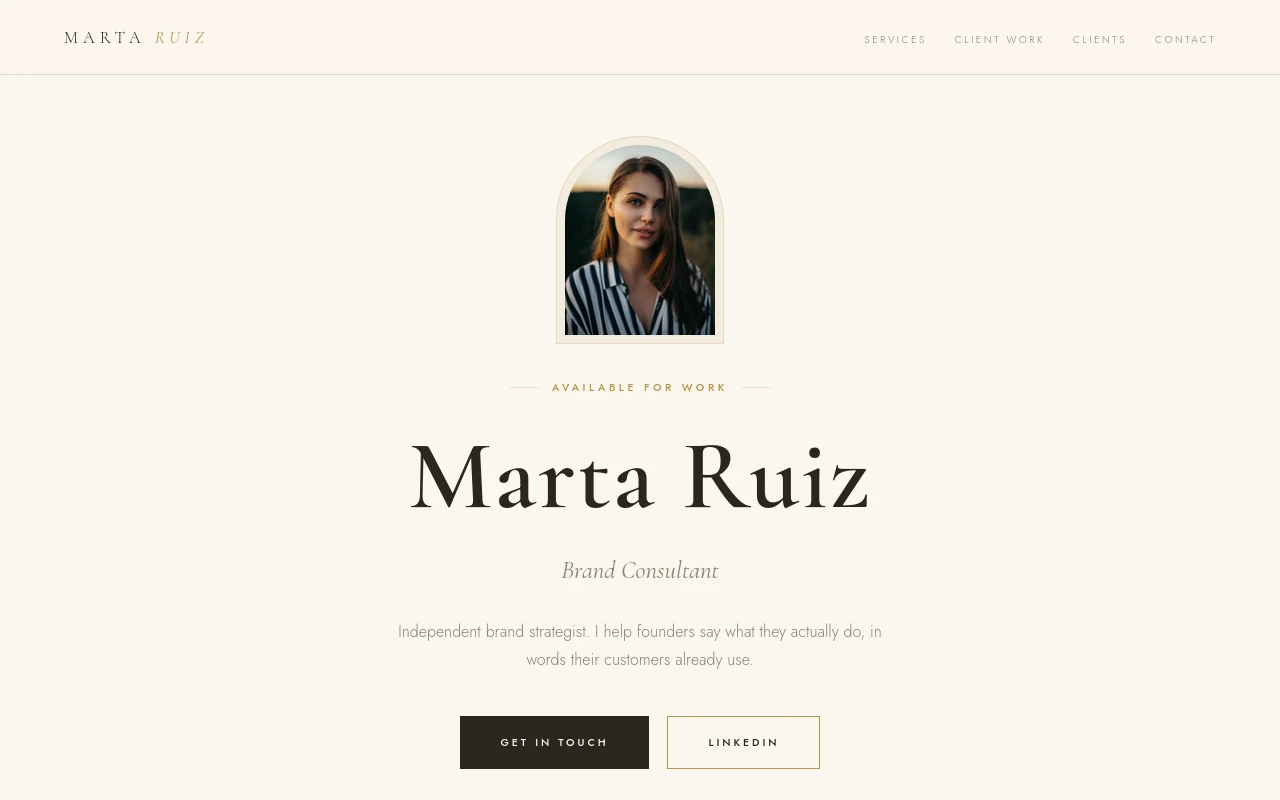
Marta Ruiz’s brand consultant demo uses the Freelancer Luxe template. Inspect the relationship between the service introduction and the project presentation, then adapt it to your actual offering.
Before you publish
- A visitor can identify my service from the first paragraph.
- Every sample says whether it is client work or a self-directed example.
- Results and testimonials are supported and approved.
- The contact section explains what to send in an inquiry.
Frequently asked questions
How do I create a freelance portfolio with no clients?
Create a relevant sample project and label it as self-directed work. Explain the intended audience, assumptions, deliverable and your process without claiming a client relationship.
Do I need to publish my rates?
That depends on how you scope work. You can describe the service and ask for a brief first. If you publish a starting price, state what it covers and keep it current.
Keep building your portfolio
Build a portfolio around your work
Choose a template, import your CV if you have one, and edit your projects. Free includes one private draft. Entry is $2/month for one published portfolio; Pro is $5/month for up to five. Both paid plans support your own domain; domain registration is separate.